
Research & Musings: The Thrill of Victory (and the Agony of Defeat!)
TV viewers from the 1960s though the 90s will recognize ABC’s ‘Wide World Of Sports’ broadcast slogan, ‘The Thrill of Victory, and the Agony of Defeat’, applied there to the tragic ending of a ski jump, and which I will apply here to the tragic ending of a research line of investigation, brought to us by the US Government Census bureau. I know they meant well, but it doesn’t make the result any easier to digest.
Our Founding Fathers saw the wisdom in providing a mechanism to enumerate (i.e. count) its citizens for the purpose of determining the number of Representatives needed to give them a voice in government affairs, based on where they lived. This mechanism necessitated certain Rules and Procedures, one of which is how long collected data, such as age, employment status and type, birthplace, marital status, and such, would remain under wraps, hidden from the Public, the term of interest in this case being (a whopping) 72 years. This restriction was adopted, of course, to shield the privacy of living citizens.
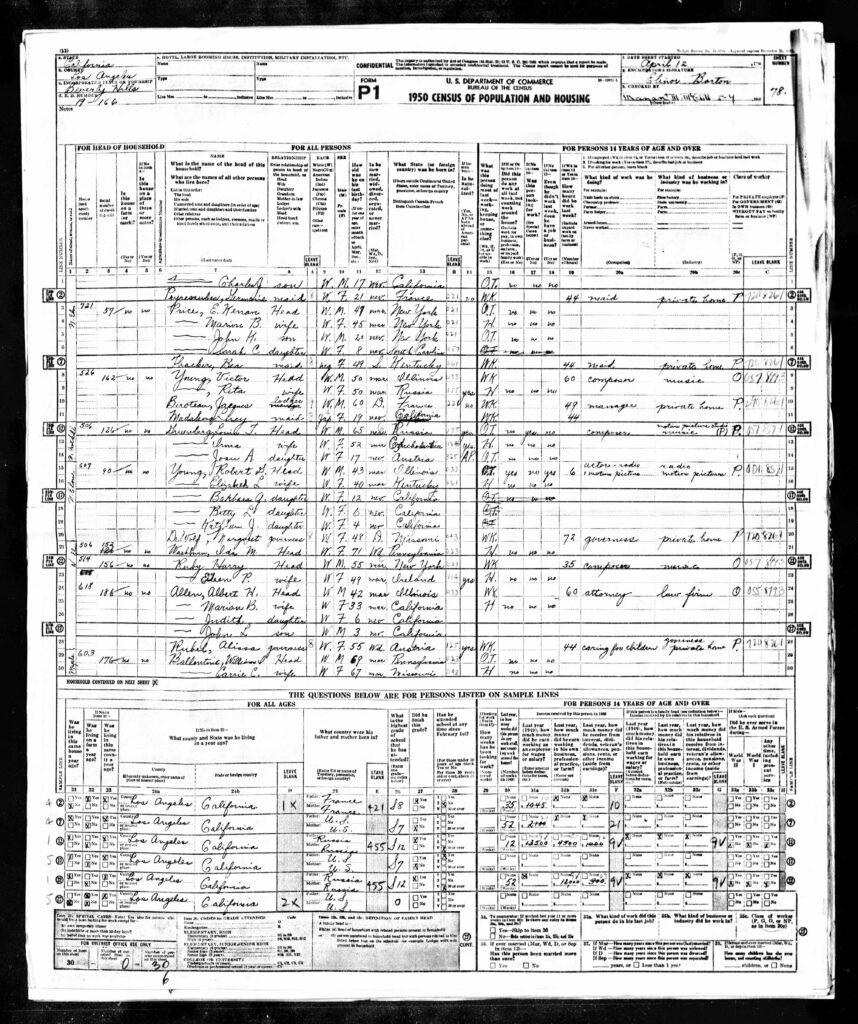
The 1950 Federal Census was released by the National Archives and Records Administration on April 1, 2022, to much fanfare, since these releases occur only once every ten years. Having exhausted the data available in the 1940 census, this researcher eagerly awaited this next issue. Since Victor Young died in 1956, the last census he appeared in was the 1950 enumeration, and this would provide a snapshot of what his Beverly Hills neighborhood was like near to his time of death. Knowing from prior years that Young often had people living with him for long periods of time, here, I anticipated, was an opportunity to find the name of a resident that might have been young at that time, and could still be, perhaps, extant on planet Earth.
The enumerator, Elinor J. Barton of Ashton Ave., Los Angeles, canvassed her assigned neighborhood from April 1st to 14th, 1950, going up one side of a street then down the other, until she had visited all residences at least once. On April 11th she came to the Young residence at 526 N. Elm St. and recorded the residents were ‘Not at home.’ As one might imagine, this was a weakness that lay at the heart of the entire census operation. Another weakness was in the data acquisition process itself: enumerators ‘listened’ for a name and wrote it down themselves, leading to many examples of miss-heard and misspelled names, or just plain unintelligible script, which litter census data and confuse today’s search algorithms and researchers. Then there are just outright errors (e.g. the dividing line between N. Elm and N. Foothill is in the wrong place). Elinor returned to N. Elm on the 12th and talked with someone there (the process unfortunately didn’t indicate whom), and listed the occupants as follows, with Age, Occupation, Industry, and Hours worked the prior week:
Young, Victor, age 50, Composer, Music, 60 hours,
Young, Rita, age 50, Wife,
Biroteau, Jacques, age 60, Manager, Private Home, 49 hours, and
Madokoro, Lucy, age 19, Maid, 44 hours.
The reader can be excused for thinking, quite practically, that the young maid in Victor’s home was probably no longer among the living, but this doesn’t reckon with the ever-present hope, springing eternal in the heart of the often disappointed researcher. Indeed, in 2022, Miss Misayo Lucy Madokoro would have ‘only’ been 91 years old, a distinct possibility, and having worked in the Young residence at a young, impressionable age would likely have accumulated a wealth of memories. Perhaps, as such things did happen in the biographies of other people I had read, she might have even kept a diary! Was the ‘Mother Lode’ near at hand? This ‘Victory’ soon devolved into crushing ‘Defeat,’ however, as I tracked the party down to her home in California, then to a recent hospice residence, then to her final resting place. Along the way I became a bit acquainted with her daughter, who confirmed there was no diary or letters, no photographs, and no interesting family stories that she could remember.
All was not lost, however. Interesting facts bubbled up to the surface of the census data, putting some rudimentary clothing on the bare bones of Victor Young’s neighborhood: actor Robert Young, with three young daughters under the age of 13, lived just a few houses up the street! Two other composers lived nearby on N. Elm St. and N. Foothill! Critic Hedda Hopper lived just around the corner! A bit of trivia that attracted my attention: four of the five adjacent homes were inhabited by Insurance Agents. (The figure of Ned Ryerson, from Groundhog Day, entered my imagination.) And then there was a hint of the work opportunities and work ethic exemplified on N. Elm St.: Victor worked 60 hours the week before, Robert Young’s Governess worked 72 hours, an Attorney living a few doors down, 60 hours, and Robert Young himself, only 6. (Was he in between roles?) Lastly, living across the street from Victor and Rita, a young girl of only 7 in 1950. (The cherub, hope, rose again! To be continued at a later date …)
Music in Focus: 'Stella By Starlight' Handwritten Score
At Paramount Pictures, some years ago, I was kindly shown an original, handwritten copy of ‘Stella By Starlight,’ with the microscopic ‘pencil sketch’ musical notation written in Victor Young’s hand and the lyrics written in Ned Washington’s hand. The very distinct, obviously authentic signature of Victor Young, was on the top of the music, so I had no doubt that I was looking at an original ‘Stella By Starlight’ copy. It might have even been the working, ruled musical note paper that Young and Washington used to finalize the addition of lyrics and an introductory verse, two years after the theme itself appeared in The Uninvited, where it had no verse and no lyrics. The bound Conductor’s score for the film, in the collection at Brandeis, regrettably disappeared to parts unknown before it could be digitized. Still, since the popular song as we know it was NOT in the film, the full song itself would not have appeared in the Conductor’s score.
Where do a famous person’s personal and professional papers, photographs, letters, and such, ‘go’ when an estate’s Executor doesn’t make provision for their safe keeping? In Victor Young’s case, the answer in 2025 is ‘we don’t know.’ They were not part of the original bequest to Brandeis University (which split off half the collection for Boston Public Library), nor were they bequeathed to UCLA. In researching the estates of lyricists Ned Washington and Ed Heyman, to name two people intimately connected to the personal and professional life of Young, nothing was donated to any library. For Young, Washington, and Heyman, materials turn up at auction from time to time, and suggest a hidden hand at some point gave away or sold these things to private collectors. This means, that someday, a cache of research materials might suddenly appear on the market, or better yet, be donated to an institution where researchers can obtain access.
This somewhat grim assessment hasn’t taken account of one other pathway, namely, the disposition of gifted materials. By ‘gifted’ I mean autographed pieces of music, autograph books containing signatures and thoughtful messages, or photographs, magazine covers, napkins from the Brown Derby, and such, which flowed out to the public sphere during the person of interest’s life, and so, having been dispersed before the thoughtful (or thoughtless) hand of an Executor took action, these can pop up from literally anywhere at any time. Happily for us, this was the case which my daily Google ‘alert’ detected when musician, Jonathan Huber, posted a video on YouTube.
Jonathan has a handwritten copy of ‘Stella By Starlight’ that was given to his uncle, the well-known tenor, Sergio Franchi, by Victor Young himself, who reportedly said that Sergio was the only singer who sang ‘Stella’ the way Young had intended. This was a staggering bit of commentary, considering the many covers Victor would have heard before 1956, such as Frank Sinatra or Dick Haymes, to name only two. The details surrounding the circumstances of this gift have not survived, but there is no doubt that this is an original handwritten copy. More than that, it was written exactly as the quiet, contemplative piano solo that Ray Milland’s character played for Gail Russell’s character in The Uninvited, in the intimate, hopeful setting of Milland’s music studio, before the supernatural intrudes in the developing love story. If you want to listen to Jonathan’s sensitive performance of the piece, that begins at approximately the 5:55 minute time stamp and ends at about 6:50. If you want to consider his detailed analysis of the chord progressions that Young wrote, listen to the end. If you would like to get a copy of the music, visit Jonathan’s Squarespace store (link below.)
Victor Young’s handwritten version of Stella By Starlight! (and analysis)
Film or Event in Focus: The Uninvited (1944)
The Paramount Pictures film scored by Victor Young, that introduced his love theme, ‘Stella By Starlight,’ and presented audiences with Hollywood’s first serious treatment of haunting. Breaking away from traditional stories where a sheeted villain attempts to scare people away from a hidden prize, ‘The Uninvited’ crackles with supernatural tension, sprinkled with witty, stage-like dialogue to lighten the overall tone. The film catapulted Gail Russell to stardom and bound up her fragile life with the Victor Young tune, which she always considered ‘her song.’ His film score explores other delightful musical themes and makes a good entry point for listening to how film music supports the action and the story. For the best experience, watch the film in a dark room.
[YouTube link to a Buy or Rent version with CC.]
Film Cue and Song in Focus: The Searching Wind (1946)
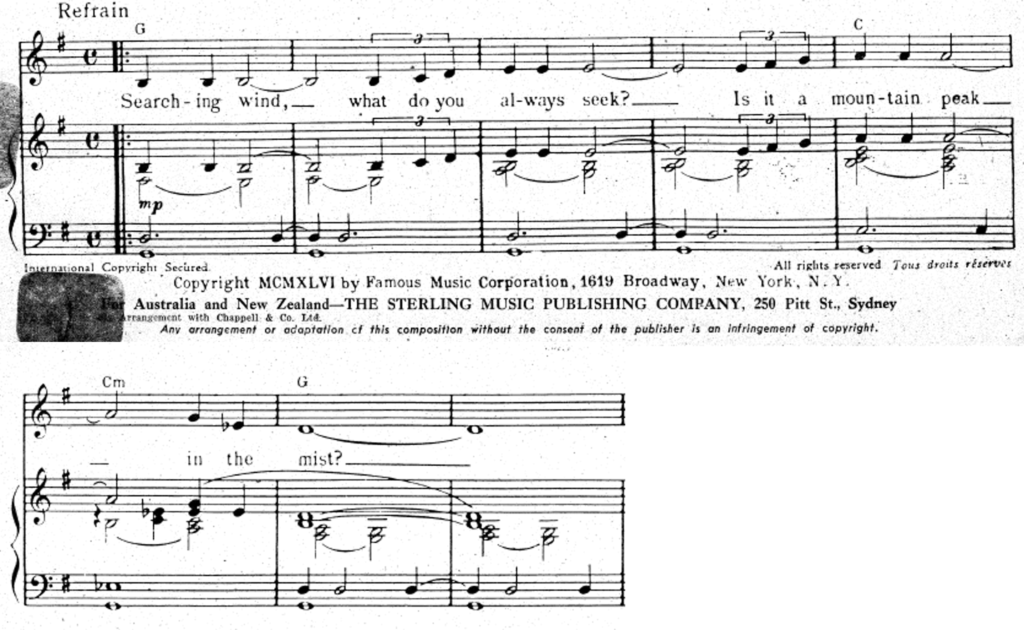
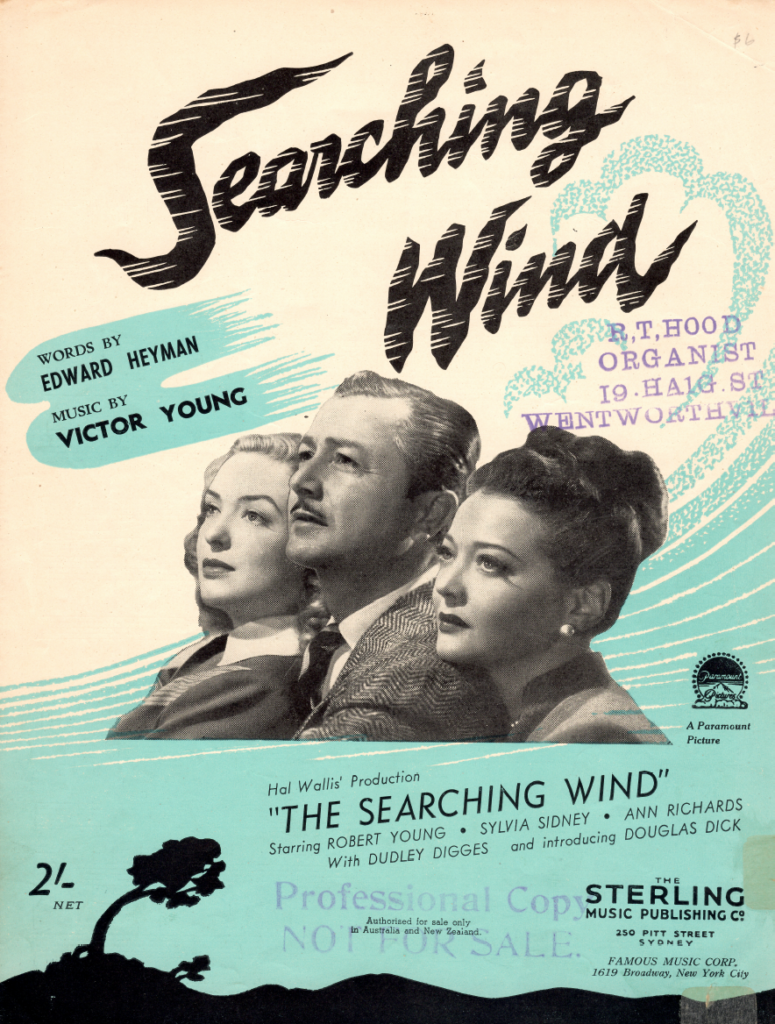
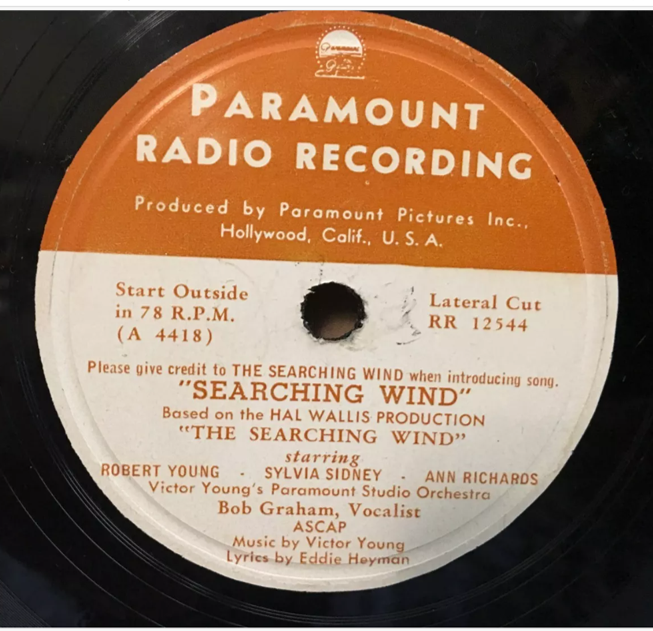
An American, career diplomat, looks back on his mistakes at the end of WW2. Starring Elm St. neighbor Robert Young, with Sylvia Sydney, and Ann Richards, The Searching Wind, produced by Paramount Pictures in 1946, gave inspiration for Victor Young to write a beautiful love theme. This was quickly released with lyrics written by Eddie Heyman. The first eight measures of the Refrain are shown below, but I have omitted the introductory Verse. The YouTube link is to a playlist with three versions of the theme, in which the listener can hear how it was originally composed and orchestrated for the film, and released as a vocal solo performed by Dick Haymes and later as an instrumental featuring a Tommy Dorsey trombone solo, accompanied by Victor Young’s orchestra for Decca. If you are not familiar with the voice and style of Dick Haymes, you are in for a treat. One other vocalist, Bob Graham, is known from a Paramount Radio Recording record label (see below). Interestingly, the ASCAP song registry doesn’t list ANY performers for this song. It seems safe to conclude that this is a relatively unknown Victor Young song, one that I hope will be revived in the future. If you follow the YouTube link and listen to all three versions, please ‘vote’ in the poll of this Newsletter page to indicate which version you prefer. If you have the Bob Graham or other recordings, please send them to me.
Biography Source in Focus: Polish National Archive
The Mława office of the Polish National Archive is supporting the biography project with Polish-language search and translation services. We are looking for documentation of Victor’s European concert tours and his often-told ‘arrest’ stories. Another subject of interest is the history of the Goldfeder family of Łódź, Poland. Banker Josef Goldfeder was a sponsor of Victor Young, gifting him a 1730 Guarneri violin to mark his graduation from the Warsaw Imperial Conservatory of Music.